Put the format inside the question
A cricket statistic arrives with a setting, even when the setting is omitted from the headline. The structure of the contest affects the opportunities available and the meaning of a passage of play. Before comparing two records, state whether they concern the same format. This small step does not solve every comparison problem, but it prevents a number from appearing more universal than the evidence beneath it.
This note is a reading framework, not a ranking of formats or a guide to current competition administration. The OSN cricket reference desk connects it to explanations of rates, samples and missing data. All numerical examples in this note are invented. They demonstrate how a comparison can be technically correct as arithmetic while remaining incomplete as a sporting claim.
Begin with the broad distinction
The ICC introduction to international formats distinguishes Test cricket, One-Day Internationals and Twenty20 Internationals. These structures give a reader different time horizons for understanding an innings or match. That high-level distinction is the source-based starting point here. It is not an exhaustive description of every domestic or community competition, and it should not be treated as one.
A competition's own current documentation may establish details that a general introduction does not. If a claim concerns a particular replacement arrangement, schedule or playing condition, find the document that actually governs it. The format name tells you an important category; it does not automatically tell you every operational rule. Scope matters when selecting a source just as it does when selecting a statistical sample.
Keep a format label with the record
Suppose you copy a batter's runs and balls into a notebook. Add the format and the period represented by those figures. If the numbers combine formats, label the combination rather than leaving another reader to infer its contents. A mixed record may answer a carefully defined question, but it is not interchangeable with a record from one format merely because both display a strike rate.
The same principle applies to team results. A list described as recent matches may contain different contest structures unless its boundary is explicit. Before calculating a win fraction or an aggregate rate, inspect the items in the list. If the intended question concerns one particular setting, exclude other settings openly and explain the decision. Do not move the boundary silently after seeing which version produces the preferred result.
An invented comparison across settings
Imagine two fictional batting passages: thirty runs from twenty balls in one setting and forty-five from thirty in another. Both produce a strike rate of 150 runs per hundred balls. The arithmetic is equal. We have not established that the opportunities, objectives or match positions were equal. A reader can report the shared rate while declining to turn it into proof that the performances had identical value.
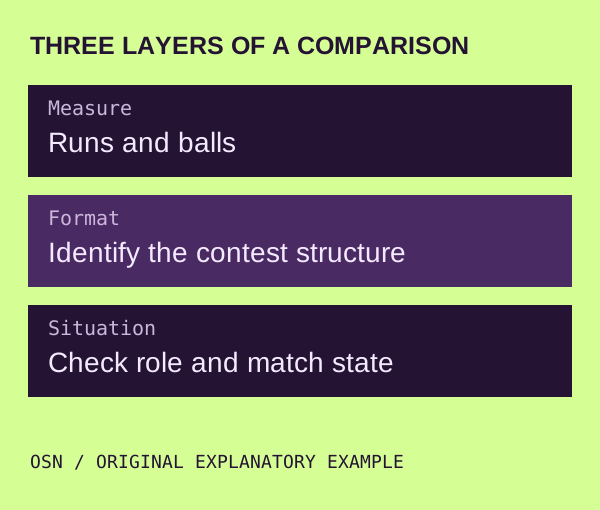
The diagram separates three layers: the calculated measure, the format label and the match situation. Keeping those layers visible helps avoid a false choice between dismissing all comparisons and accepting every tidy ratio. Some cross-format questions are legitimate, but the claim must explain what is being compared and which contextual differences remain. The difficulty is not the multiplication by one hundred; it is the interpretation attached to the result.
A useful question might concern how a particular measure behaves across explicitly defined samples. A much larger question might concern who is the better player overall. The same two fictional passages cannot support both claims equally well. Choose the smaller question when the evidence is small. The presence of a shared unit makes calculation possible; it does not make every possible conclusion defensible.
Separate format from phase and role
Even within one format, passages can have different settings. A player's task, the stage of an innings and the team position may affect how a record should be discussed. Naming the format is therefore the beginning of context rather than its completion. A comparison can pass the first check and still need a more careful account of the opportunities represented.
Avoid using context as an all-purpose excuse that can never be tested. State which difference matters to the specific question and why. If you believe two samples are not comparable because of role, describe the role distinction in observable terms. If the evidence does not establish the role, keep that uncertainty visible. A contextual argument should become more concrete as it develops, rather than retreat into vague claims that every performance is unique.
Decide what to aggregate
Combining records is a choice about meaning as well as arithmetic. If you aggregate runs and balls from different formats, say that the resulting rate describes the combined counts. It does not preserve every distinction between the original appearances. Keep the component records available so that a reader can inspect whether one setting dominates the total or whether a change in composition explains a change in the displayed rate.
For example, a combined rate can change when the balance of opportunities changes even if the component patterns do not move in the same way. This is a reason to examine the underlying counts before announcing improvement or decline. The short-sample note discusses why the amount of exposure remains important even after a record has been converted into a familiar per-unit measure.
Keep dates and versions attached
A format label without a date can still leave a comparison ambiguous. A source may summarise a player's entire available career while another covers a recent period. Those records differ in more than format. Write down the coverage before discussing the output. If a source later corrects its data, record the version that supports the calculation and reconsider any conclusion that relies on a changed input.
This is especially useful when reading older articles beside current statistics. An older figure need not have been wrong at publication to differ from the current record. Treat it as a dated observation rather than a timeless value. A careful comparison distinguishes changes in the underlying record from errors in reporting. Without that distinction, an ordinary update can be misread as evidence that one of the sources was unreliable.
Finish with an explicit boundary
A concise final paragraph can state the format, the sample period, the measure and the remaining contextual limits. That gives another reader enough information to reproduce the comparison or challenge its design. You do not need to settle an overall ranking to make a useful observation. Sometimes the strongest result is that two records answer different questions and should be discussed separately.
For additional terminology, Cricketin's cricket reading pages are a sponsored partner reference. The primary format distinction above comes from the ICC; our fictional passages and comparison method are original explanatory material. Keep those roles separate. A format-aware reading does not drain sport of argument. It makes the argument easier to understand by showing which cricket is being discussed before deciding what its numbers mean.
A practical comparison card
Before drafting the conclusion, write four short lines: the format represented, the period covered, the unit calculated and the contextual difference most relevant to the question. If one line remains unresolved, keep that gap in the written account. This small card makes the sample design visible without requiring a complex statistical model. It also prevents a later edit from shortening the headline until the format restriction has vanished.
For example, a statement about a particular format during a specified competition phase should retain both qualifications when quoted elsewhere. Removing them changes the claim. The number itself may be unchanged, but the apparent scope becomes larger. Preserving that scope is an editorial responsibility, not merely a technical preference about tables.