An average with a particular denominator
Batting average divides a batter's accumulated runs by the number of times the batter was dismissed in the defined sample. It does not simply divide by innings played. That distinction explains why two records containing the same number of innings and runs can produce different averages. Before interpreting the display, inspect the innings, the not out entries and the dismissals. The denominator is a meaningful part of the statistic, not an administrative detail to be hidden behind the final number.
This reference note uses fictional records so that every step can be checked. It does not describe a real player's career or claim that one statistic provides a complete ranking. The purpose is to understand what the calculation measures and what it leaves unresolved. A reliable source should identify the sample and retain the input counts. If it supplies only the average, resist the urge to reconstruct a whole batting history from a number that cannot contain that much information.
Build the record before calculating
Imagine a fictional three innings record: twenty runs and dismissed, thirty runs and not out, then ten runs and dismissed. Total runs are sixty. There are three innings but only two dismissals, so the batting average is sixty divided by two, giving thirty. Dividing by the three innings instead would give twenty, which is runs per innings for this sample. Both calculations are possible, but they answer different questions and must not receive the same label.
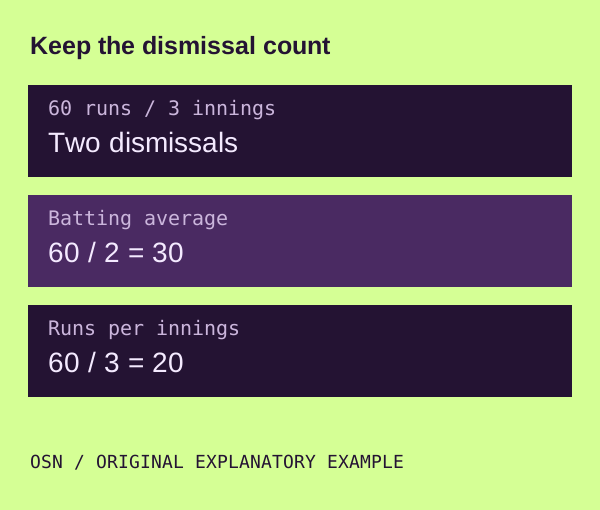
The not out innings contributes its runs to the numerator while adding no dismissal to the denominator. That is why the record needs more information than a list of innings totals alone. A small mark beside a score can change the interpretation of the aggregate. When copying data, preserve the dismissal status rather than carrying over only the visible runs. A transcription that removes the not out distinction can produce a convincing but incorrectly labelled average.
Compare equal totals carefully
Consider a second fictional record with sixty runs across three innings, all ending in dismissal. Its batting average is twenty. The first example's average of thirty is higher because its denominator contains two dismissals rather than three. The difference is a clear arithmetic consequence of the supplied records. It is not, on its own, proof that the first batter played a better role, faced a harder attack or would outperform the second in a future match.
The original diagram for this note keeps the same run total while changing the dismissal count. That makes the denominator's effect easy to inspect without introducing a claim about an actual player. Use the diagram as a definition exercise. If you want to evaluate performance in context, the next questions concern match state, opportunity, format and a broader record. Do not mistake the clarity of a teaching example for evidence that real comparisons can be settled with equal ease.
No dismissals is a special case
A sample with runs but no dismissals has a zero denominator. Ordinary division does not produce a finite batting average in that case. A display may use a dash or another explicit convention, but the underlying issue should remain clear. Do not silently substitute total runs, zero or an arbitrary large number and then compare it with conventional averages. The display needs to distinguish an undefined ratio from a measured value that happens to be small or large.
A record containing no dismissals is still a record. You can describe the runs and innings directly without manufacturing the unavailable ratio. For example, an invented pair of not out scores can be reported as a run total across two innings. That statement remains useful and accurate. A missing average does not mean the batting contribution was worthless, nor does it establish unlimited ability. It means that this particular statistic cannot be calculated as a finite number from those inputs.
Combine the underlying counts
Suppose one fictional sample contains sixty runs from two dismissals and another contains forty runs from four dismissals. Combined, there are one hundred runs and six dismissals, giving an average of sixteen and two thirds. Simply averaging the separate displayed averages of thirty and ten would produce twenty. That is a different summary because it gives the two samples equal influence despite their different dismissal counts. Define the summary you intend before deciding how to combine it.
The companion note on combining unequal samples develops the broader principle: an aggregate ratio usually comes from combined compatible numerators and denominators. For batting average, the relevant denominator is dismissals. For another measure, it may be balls or wickets. Weighting is not an optional mathematical flourish. It follows from what the ratio actually means. Using the wrong count as a weight changes the question while leaving the table looking almost unchanged.
Keep speed out of the average
Batting average says nothing directly about how many balls were used to score the runs. A batter might reach the same run total at different speeds in different samples. That is why batting strike rate exists as a separate measure. An average of thirty does not imply thirty runs per hundred balls, and a strike rate of one hundred and fifty does not imply an average of one hundred and fifty. The shared use of numbers does not make the concepts interchangeable.
Read the note on batting strike rate alongside this one when a table places both measures together. Each can add information, but neither automatically completes the picture. A comparison becomes more intelligible when the writer says whether the question concerns scoring speed, runs per dismissal or something else. Adding multiple statistics without defining their purpose can obscure a claim just as effectively as relying on a single oversized number.
Read the sample boundaries
A statistic needs a beginning and an end. A career record, a recent tournament and a selected run of innings may all produce different averages without any calculation being wrong. The question is whether the selected sample matches the claim being made. A short strong passage should not be presented as a settled career assessment. A broad career average should not erase a specific change that a carefully defined recent sample is intended to investigate.
Format is another boundary worth preserving. The ICC overview of international formats offers background on different innings structures. When comparing actual records, keep the format and competition labels attached rather than treating every innings as the same opportunity. This reference does not prescribe universal benchmarks or claim that a particular average is automatically good in every setting. Such judgments need the context and comparison group that a simple definition cannot supply.
Give the reader the record, not only the result
A clear summary includes total runs, dismissals, innings, the calculated average and the sample description. Not every prose sentence needs all five items, but the supporting table should make them available. Preserve original counts when rounding a display, and check a changed input before reusing an old conclusion. A ratio is easier to trust when another reader can reproduce it. That transparency does not remove uncertainty about a future innings; it simply makes the descriptive calculation inspectable.
Return to the OSN reference index for the surrounding definitions. A sponsored link to Cricketin's cricket reading provides another explanatory resource, separate from our invented records and primary source material. The useful habit is to ask what sits beneath the average. Once the dismissals and runs are visible, the calculation is simple, and the larger sporting interpretation can be discussed without pretending that the denominator has already answered it.