Define what the dot means
A dot-ball percentage looks simple: count the relevant non-scoring deliveries, divide by the number of deliveries in the sample and multiply by one hundred. The difficulty lies in the word relevant. A team score, a batter's contribution and a bowler's record do not necessarily classify every event in the same way. Before calculating, state whether your question concerns a team passage, an individual batter or a particular bowling spell. Then use a consistent definition throughout.
This note uses an invented team-level example with a deliberately explicit convention: a dot is a legal delivery on which the team total does not increase. It is a teaching convention for this exercise, not a claim that every data provider uses identical categories. The OSN cricket reference desk links the measure to the rest of the scorecard. A percentage is helpful when the underlying event and denominator remain visible beside it.
Draw the sample boundary
Choose a completed passage before looking for the most flattering number. You might examine one invented sequence of twenty legal deliveries. Write down where the sequence begins and ends, then classify each delivery under the stated convention. Do not silently exclude a delivery because its outcome complicates the calculation. If an event does not fit the convention or the source lacks the detail needed to classify it, record that limitation explicitly.
An individual batting sample may require a different denominator from a team-level passage. That difference is a reason to label the calculation, not an invitation to mix the two. A reader should be able to identify which deliveries were eligible and why. If a source already displays a dot-ball percentage, look for its definitions before comparing it with a percentage from another source. Matching labels do not always guarantee matching event categories.
Calculate an invented sequence
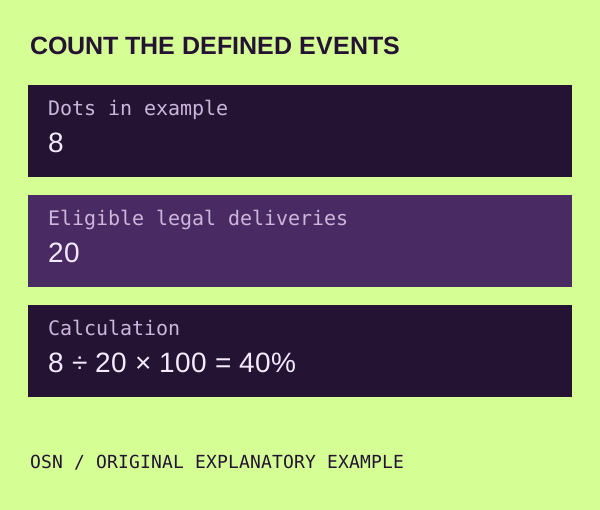
Suppose a fictional passage contains twenty legal deliveries. Under our team-total convention, eight produce no increase in the team score and twelve produce an increase. Eight divided by twenty equals 0.4; multiplying by one hundred gives forty percent. The calculation describes this particular passage under this particular definition. It is not a statement about the batter's overall ability, the bowler's future success or the probability of winning the match.
The companion diagram keeps all three quantities together: eight qualifying events, twenty eligible deliveries and forty percent. This is more transparent than presenting the percentage alone. Another reader can reproduce the operation and challenge the convention if it does not answer the intended question. A well-labelled denominator turns a compact statistic into an inspectable summary rather than a decorative number in a match discussion.
Now add ten more fictional legal deliveries, of which two qualify as dots. The combined sample contains ten dots across thirty deliveries. The combined percentage is approximately 33.3 percent. It is not obtained by casually averaging forty percent and twenty percent, because the two passages contain different numbers of deliveries. Combining the underlying counts preserves the weight of each passage. The same principle matters whenever short and long samples are brought together.
Keep extras and attribution visible
A team may receive runs through categories that are not credited as a batter's scoring strokes. This is why a statement about whether the team total increased must not automatically become a statement about runs credited to one batter. Use the actual event information and the relevant scoring definitions rather than trying to reconstruct everything from an individual runs column. If the source does not give the necessary breakdown, a precise-looking classification may not be possible.
For formal scoring questions, consult the applicable Laws and competition conditions rather than extrapolating from this simplified example. The MCC introduction to the Laws explains why governing material and playing regulations need to be distinguished. This article does not attempt to replace those documents with an exhaustive event taxonomy. Its narrower purpose is to show how a definition determines what a percentage can legitimately describe.
A dot is an event, not a motive
A non-scoring delivery does not establish why no run was scored. It may be tempting to call every dot evidence of pressure or every sequence of dots evidence of a failed plan. Those are interpretations requiring context. The team position, the available opportunities and the visible play may support a particular explanation, but the percentage alone does not supply it. Keep the observation and the explanation in separate sentences.
Likewise, a low dot percentage does not prove that an innings was better in every relevant sense. A summary can show how frequently a defined event occurred without measuring its complete value. The boundary contribution note illustrates another incomplete but useful view of scoring. Reading the two measures together can generate questions; it should not become an unsupported formula that claims to explain all batting performance.
Compare compatible opportunities
Two forty-percent records can come from very different samples. One might cover five legal deliveries and the other fifty. The displayed percentage hides that difference unless the denominator is reported. Even when the counts are available, different roles and match states can make a direct comparison misleading. Define the comparison first, then ask whether the chosen samples actually address it on similar terms.
There is no universal minimum number of deliveries that makes every interpretation safe. The strength of a conclusion depends on the question and the nature of the observations. A small sample can accurately describe a small passage; the error is treating that description as a settled assessment of a person. Report the sample size, acknowledge contextual differences and resist the urge to turn an available ratio into a permanent label.
Handle incomplete event data
If two deliveries in a twenty-ball passage cannot be classified from the source, do not invent their outcomes. You can report that eight of the eighteen classifiable deliveries meet the convention, provided you clearly identify the restricted denominator. You cannot quietly call the result the percentage for all twenty deliveries. The missing events could affect the answer, so the limitation belongs beside the calculation rather than in an unrelated note.
The missing-data explanation develops this distinction between unknown and zero. It is especially useful when comparing a full score feed with a partial commentary extract. The richer source may support a classification that the extract cannot. A responsible analysis adapts its claim to the available evidence instead of making the sparse source look complete by filling its gaps with convenient assumptions.
Write a reproducible summary
A strong final sentence gives the convention, the count, the denominator and the scope: in this invented twenty-delivery team passage, eight legal deliveries produced no increase in the team total, giving forty percent under our stated definition. That is longer than a bare percentage, but it answers the reader's most important questions. It also makes subsequent corrections straightforward because the calculation's inputs are known.
For further terminology, Cricketin's cricket explainers are a sponsored partner reading reference. They are separate from the governing sources and from the fictional event counts used here. Keep those categories clear when continuing the discussion. The useful result is not a magic assessment number; it is a transparent description of a defined passage that another reader can check and place in context.
Keep the event log beside the percentage
If you preserve the delivery classifications, a disputed count can be checked without repeating the whole exercise. Mark the sample endpoints and the convention once, then retain the sequence that produced the tally. This is particularly helpful when a correction changes one event from qualifying to non-qualifying. You can update the numerator openly and explain whether the denominator changed as well.