Read the edge of the frame
A cricket clip is a selection with boundaries. It begins at a chosen moment, shows a chosen view and ends before the rest of the match unfolds. Those boundaries do not make it unreliable. They tell you which questions it may answer and which questions need more material. A close replay can illuminate an action while concealing the field. A highlight can capture a dramatic event while omitting the ordinary deliveries that made the event meaningful to the players watching it arrive.
This note is about reading edited sporting evidence. It is new English cricket material at a retained historical video address, not a medical explanation or a reproduction of earlier content associated with that route. The examples are fictional and identify no real player or match. The aim is to help a reader distinguish the visible action from the wider claim attached to it, and then decide what additional source would make that claim easier to assess.
Describe what you actually saw
Start with a short account that does not borrow its explanation from the caption. Did the clip show the full approach and delivery, or only the moment of contact? Could you see the surrounding field, or did the camera remain close to the batter? Was the score graphic visible long enough to identify the innings and stage? These questions establish the evidence available. They are not accusations about the editor's motives or proof that an accurate selection has misled anyone.
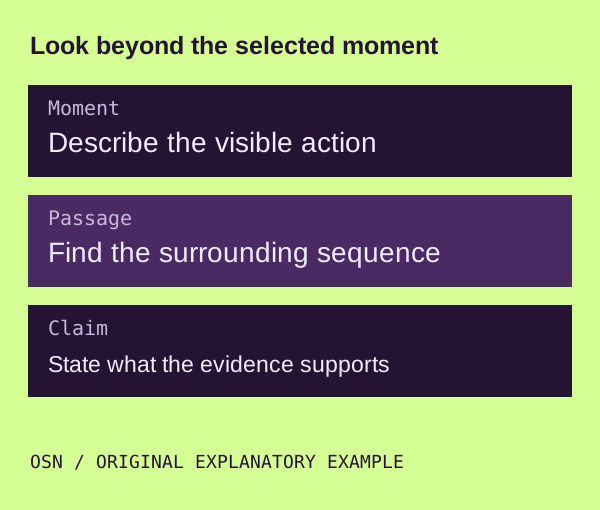
Imagine a fictional clip showing a boundary followed by a celebration. You can describe both events. You cannot infer the entire innings, the batter's intended plan or the difficulty of the previous passage from those images alone. A caption may offer that wider account, but it remains a claim to examine. Preserve the clip's direct observation in one sentence and the proposed interpretation in another. Keeping them separate makes it easier to revise the interpretation without losing the useful observation.
Look for the surrounding passage
The preceding sequence may explain why a particular action attracted attention. A quiet passage, a change of bowler or a field adjustment can provide context that a short highlight lacks. Seek a fuller replay or an event record when the wider claim depends on those details. Do not assume that unseen deliveries were unimportant simply because they were omitted. Editing often selects the most visible consequence, while an explanation may depend on the less spectacular choices that came before it.
The original diagram for this note moves from the selected moment to the surrounding passage and then to the conclusion. Each step asks for a different kind of evidence. The sequence is a reading framework, not a prediction tool. It does not require you to reconstruct an entire match for every enjoyable clip. It provides a practical method for the occasions when somebody uses the clip to support a strong claim that deserves more than an immediate agreement or dismissal.
Read the graphic as another source
A score display can add valuable information, but it also needs labels. Identify whether the number concerns the team, a batter, a partnership or a projection. Notice whether the figure covers the whole innings or a selected phase. A partial graphic may omit the denominator behind a rate. If you cannot see the relevant balls or deliveries, do not invent them to reproduce a number that looks familiar. Record the limitation and find a fuller source if the calculation matters.
A replay may also show information from an earlier moment than the broadcast's current score. Keep the time relationship clear before combining visible numbers. An event graphic and a live score can both be correct while referring to different points in the match. The problem arises when a reader quietly treats them as one simultaneous record. Good observation begins by asking what the display actually identifies, rather than assuming that proximity on the screen means every figure belongs to the same sample.
A repeated replay is not another event
Watching the same action from several angles can clarify it. It does not add several independent occurrences to a statistical sample. A montage can also make a pattern feel more frequent than the underlying record establishes, because the editor selected instances of the action being discussed. To assess frequency, you need a defined set of opportunities and a count of relevant events. A collection of examples can illustrate a movement without measuring how often it happens across a complete innings or career.
This distinction matters when commentary moves from a visible action to a statement about a player's permanent style. The clip may support a narrow description of the action in that moment. A broader claim requires a broader and clearly selected record. Ask which material was included and which comparable events were left out. The selection might be entirely reasonable for the video's purpose, but it should not silently become a comprehensive sample simply because the final montage feels persuasive.
Check what the format changes
The same visible action can occupy different strategic settings in different formats and phases. The ICC introduction to international formats provides broad background for that framework. It does not determine whether a particular shot was the correct choice in a specific situation. For that question, you need the actual match state and relevant competition information, and even then a player's intention may remain an inference rather than an observable fact.
Do not fill missing context with a rule or convention remembered from another event. If the clip does not establish the target, remaining deliveries or applicable conditions, keep those gaps visible. You may still have enough evidence for a useful narrow claim about execution or the recorded outcome. The explanation becomes weaker when it pretends to resolve a strategic question from a view that cannot show the necessary context. Reducing the scope is often more honest than adding an unsupported assumption.
Try one competing interpretation
Before settling on an explanation, ask whether another plausible account fits the same visible events. A boundary might reflect a deliberate adjustment, a different opportunity or an execution error by the opposition. The clip alone may not distinguish them. You do not need to manufacture equal alternatives when evidence clearly favours one account. The exercise is to notice whether your preferred story depends on a detail you did not actually observe and have not verified elsewhere.
Choosing a source for each cricket question helps identify the next useful material. An official record can establish the event sequence, a rule document can define the framework and a fuller replay may illuminate the action. None automatically establishes every part of an interpretation. Follow the source that answers the specific uncertainty rather than collecting unrelated authoritative links and hoping their combined appearance will strengthen the original claim.
Share the clip with a proportional caption
A useful caption tells the next viewer what the clip shows and what remains outside it. Say whether you watched a full passage or only the edited selection. Keep an original calculation separate from the recorded match information. Link to the fuller source when it is available, and avoid suggesting that a governing body endorses your interpretation because its rules were consulted. A modest claim with a clear basis is easier for another reader to revisit than a sweeping verdict tied to one memorable image.
The OSN cricket reference index connects this reading exercise with the calculation notes. A sponsored reference to Cricketin's explanatory cricket material offers another destination for readers, separate from primary records and our fictional examples. A clip can remain exciting after its limitations are understood. The point is not to remove the pleasure of a striking moment, but to keep the journey from that moment to a larger claim visible enough that someone else can follow it.