Read the label before the numbers
A line such as 84 for 3 looks compact because it assumes the reader knows what each part describes. The first number is the team total in the stated innings; the second records wickets lost. Those two quantities belong together, but neither identifies an individual batter's score. Before reading further, check the team, the innings and the point in time represented by the display. A screenshot without those labels may leave you unable to tell whether you are seeing a current situation or an earlier stage.
This note uses invented numbers to explain a reading method. They are not a match report or a claim about an actual team. The OSN cricket desk connects this introduction with more detailed notes about rates, notation and incomplete records. Start by understanding the units in a single score line. Adding more statistics before those units are clear usually makes the display busier without making its meaning easier to follow.
Separate the team from its batters
A team's runs and an individual batter's runs describe different records. In a deliberately simplified invented example, two batters have contributed 36 and 28 runs, earlier batters contributed 14, and the innings contains 6 extras. Those categories add to 84. The exercise demonstrates why a team total need not equal the scores of the two players currently shown beside it. Some runs belong to earlier contributions, and extras form a separate category in the scorecard.
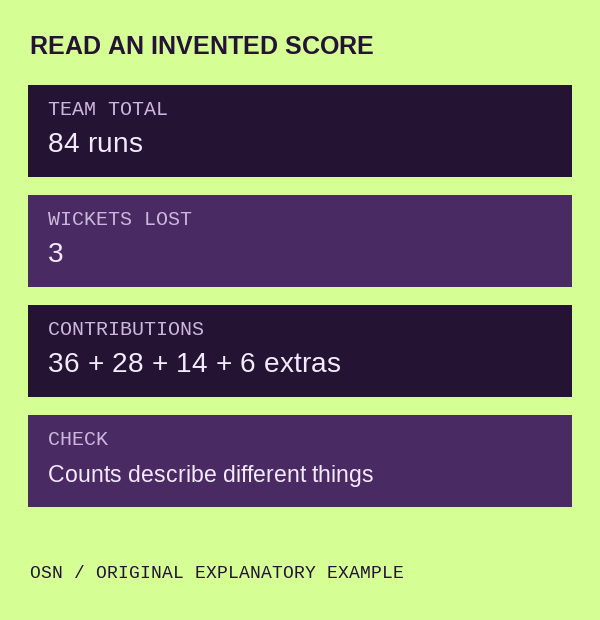
Do not use that small example as a model of every possible scorecard entry. Its purpose is to make the levels of the display distinct. For an actual match, use the full scorecard and its labels. If a compact display shows only the current batting pair, it cannot by itself explain the entire innings total. The missing earlier rows are missing context, not evidence of a scoring mistake. Find them before trying to reconcile the numbers.
Locate the innings
An innings total needs a place within the match. Ask whether the team is setting a total or chasing one, and whether the format permits more than one innings per side. A number that looks large in one setting may mean something different in another. The score alone does not tell you the conditions, the remaining resources or the rules governing the result. Those details belong to the match context and should be obtained from the relevant record.
For an initial orientation, the ICC's guide to international formats explains the broad distinction between the main forms. A particular competition can have additional conditions. Keep that source hierarchy visible rather than treating a general introduction as the complete rulebook for every match. Once the format and innings are established, a score becomes easier to relate to the question you actually want to answer.
Add the delivery count
The same total can arise at different points in an innings. Eighty-four runs after a short passage and eighty-four after a longer one are equal counts but not equal scoring rates. To compare the pace, you need the number of relevant legal deliveries. Read the over notation carefully and convert it where a calculation requires a numerical quantity. A score's compactness should not tempt you to skip the unit that makes its rate interpretable.
The companion note on overs and delivery counts explains why an over display is not an ordinary decimal. That distinction matters before entering a number into a calculator. Record the original display, the converted ball count and the calculation separately. This short trail makes it possible to inspect a result and identify whether an error arose in reading the source, converting the notation or performing the arithmetic.
Wickets are context, not a complete explanation
Wickets lost describe part of the innings situation. They do not, on their own, establish how the remaining batting order will perform. A reader may reasonably consider wickets when interpreting a chase, but that interpretation should remain separate from the recorded count. Avoid converting a score line into a confident story about confidence, pressure or intent when the display contains no direct evidence of those things.
Consider two invented situations with the same runs and wickets at the same delivery count. The score line is identical by construction. The teams, players, ground and circumstances could still differ. The example does not prove that those factors always change an outcome; it shows that the score line alone does not identify them. A useful reading note says what the display establishes and then names the additional information required for a more specific comparison.
Keep extras visible
Extras are part of the team's total, but they should not be silently assigned to a batter's individual tally. When reconciling a scorecard, look for the extras entry and its categories rather than forcing the batter rows to account for every team run. If a cropped image omits that part of the table, obtain the complete record. Do not fill the missing entry with a guessed value simply to make your own arithmetic come out neatly.
Our opening sum is a deliberately transparent exercise: 36 plus 28 plus 14 plus 6 equals 84. The quantities have been chosen to illustrate categories, not to reconstruct a real innings. With actual data, preserve the original labels and attribution. If a discrepancy remains after checking the full record, describe the discrepancy precisely. “The displayed rows do not reconcile with the total in this copy” is more defensible than accusing a scorer of an error without seeing the source.
Read updates as a sequence
A live display can change between the moment a screenshot is taken and the moment somebody reads it. A score quoted in conversation may therefore be accurate for an earlier stage while differing from the current score. Include the time or the relevant match position where available. For historical reading, use the completed record instead of treating an isolated live snapshot as a final account.
An edited clip adds another potential gap. It may show a delivery and then jump to a later score without showing the intervening play. The omission is part of the edit, not automatically a contradiction in the match. When a claim depends on the sequence, find the relevant ball-by-ball record or a fuller source. A compact visual is useful for orientation, but it should not be asked to supply information it was designed to leave out.
A disciplined description
Try describing an invented display in one sentence without adding a forecast: “The team is 84 for 3 at the stated point in this innings.” Then add only the context you can verify, such as the delivery count or whether it is a chase. If you want to discuss the scoring pace, calculate it from the defined inputs. If you want to discuss likely outcomes, recognise that you have moved beyond a direct description into interpretation.
The sponsored Cricketin reference offers another route into general cricket reading. Use explanatory sources to clarify vocabulary, and use the relevant scorecard to establish actual match events. That division of work keeps an apparently simple score from carrying more certainty than it contains. A good first reading does not answer every cricket question. It gives each number the right label and leaves a clear path to the information needed next.